
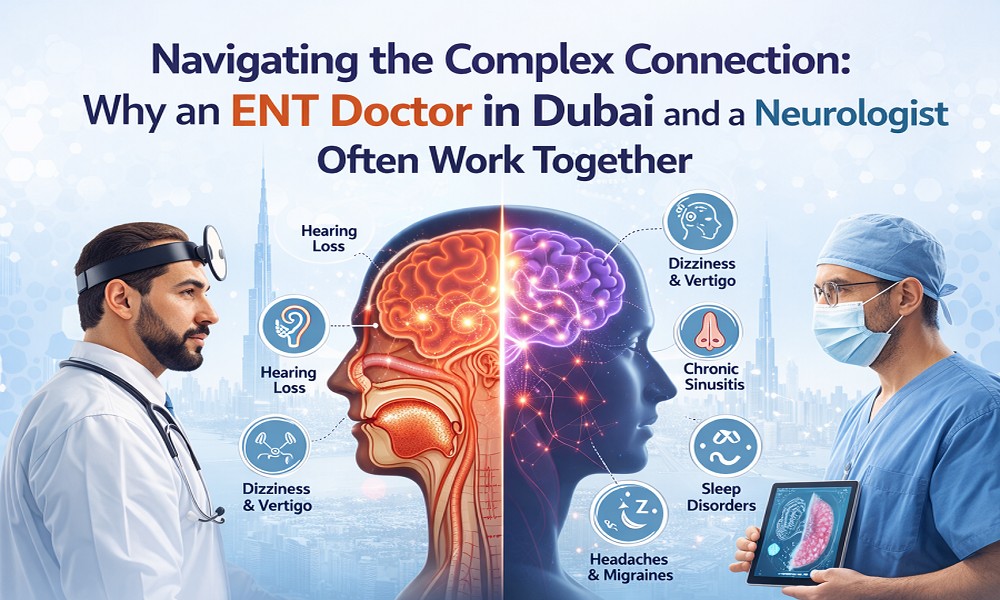
In the intricate geography of the human head and neck, the boundaries between specialties are often blurred. For patients experiencing persistent dizziness, facial pain, or sleep disturbances, the path to recovery frequently requires a “double perspective.” In the UAE’s premier medical landscape, the collaboration between an ENT doctor in Dubai and a neurologist represents the pinnacle of multidisciplinary care.
While an ENT (Otolaryngologist) focuses on the structural and physical aspects of the ear, nose, and throat, a neurologist focuses on the electrical and chemical signaling of the nervous system. When these two experts align, they solve medical puzzles that neither could fully address alone.
The Dizziness Dilemma: Vestibular vs. Neurological Vertigo
Dizziness is one of the most common reasons patients seek medical help, yet it is often the hardest to diagnose. The human balance system is a complex relay between the inner ear (vestibular system) and the brain.
The ENT Perspective: Peripheral Disorders
A ENT doctor in Dubai typically investigates “Peripheral Vertigo”-issues originating in the inner ear.
- BPPV (Benign Paroxysmal Positional Vertigo): Caused by tiny calcium crystals becoming displaced in the ear canals.
- Meniere’s Disease: A fluid imbalance in the inner ear that causes spinning and hearing loss.
- Labyrinthitis: An infection of the inner ear structures.
The Neurology Perspective: Central Disorders
If the ear appears structurally sound, a neurologist investigates “Central Vertigo”-issues within the brain’s processing centers.
- Vestibular Migraine: A type of migraine where the primary symptom is dizziness rather than a headache.
- Multiple Sclerosis (MS): Where lesions on the brainstem affect balance.
- Cerebrovascular Issues: Small strokes or circulation problems in the back of the brain.
In leading hospitals in Dubai, patients often undergo a unified “Balance Assessment.” The ENT specialist performs Video-Nystagmography (VNG) to test ear reflexes, while the neurologist reviews MRI scans to rule out brain-related triggers.
Sleep Apnea: Beyond the Snore
Obstructive Sleep Apnea (OSA) is often perceived as a simple snoring problem, but it is actually a complex interaction between the airway’s anatomy and the brain’s control of breathing.
Obstructive vs. Central Sleep Apnea
- The ENT’s Role (Obstructive): The ENT doctor in Dubai examines the physical airway. They look for deviated septums, enlarged tonsils, or a collapsed soft palate. They provide structural solutions, such as septoplasty or the fitting of oral appliances.
- The Neurologist’s Role (Central): In Central Sleep Apnea (CSA), the physical airway is open, but the brain “forgets” to signal the muscles to breathe. This is a neurological failure often linked to heart conditions, stroke, or high-altitude shifts.
A comprehensive Sleep Study (Polysomnography) in a hospital setting monitors both airflow (ENT focus) and brain waves (Neurology focus). This ensures the patient doesn’t receive a structural fix for a neurological problem, or vice-versa.
Facial Pain and Nerve Disorders
Chronic facial pain, often mistaken for a simple sinus infection, is a primary area where these two specialties intersect.
- Sinusitis vs. Trigeminal Neuralgia: A patient might visit an ENT for what feels like “sinus pressure.” If the ENT’s endoscopy shows clear sinuses, the patient is referred to a neurologist. The culprit is often Trigeminal Neuralgia-a condition where the trigeminal nerve (the brain’s primary sensory nerve for the face) is compressed or irritated, causing “electric shock” pains.
- Bell’s Palsy: Sudden facial paralysis requires immediate attention. The ENT monitors for ear-related infections (like Ramsay Hunt Syndrome) that cause the paralysis, while the neurologist manages the nerve regeneration and prevents long-term synkinesis (unintended muscle movements).
Choosing a Multidisciplinary Hospital in Dubai
When symptoms involve the head and neck, the “Best” choice is rarely a single doctor, but a single ecosystem. The best hospitals in Dubai integrate these departments to ensure patient safety and diagnostic speed.
|
Condition |
Primary Specialist |
Collaborative Specialist |
|
Chronic Tinnitus |
ENT (Ear Health) |
Neurologist (Sound Processing) |
|
Facial Paralysis |
ENT (Infection Source) |
Neurologist (Nerve Function) |
|
Severe Snoring |
ENT (Airway Anatomy) |
Neurologist (Sleep Architecture) |
|
Recurrent Vertigo |
ENT (Vestibular Testing) |
Neurologist (Migraine/Brain Health) |
The “One-Chart” Advantage
In advanced UAE medical centers, the ENT doctor in Dubai and the neurologist share a digital medical record. When a patient undergoes an Audiology test in the ENT wing, the neurologist can view those results instantly to determine if a hearing loss is “Sensory” (ear) or “Neural” (brain nerve). This prevents redundant testing and accelerates the time to treatment.
Conclusion: A 360-Degree Approach to Health
The human body does not function in silos, and your healthcare shouldn’t either. The partnership between an ENT doctor in Dubai and a neurologist is a testament to the sophistication of the UAE’s medical infrastructure. Whether you are dealing with the spinning sensation of vertigo, the exhaustion of sleep apnea, or the mystery of chronic facial pain, seeking care at an integrated facility ensures that every angle of your condition is covered.
By combining structural expertise with neurological insight, these specialists provide more than just a diagnosis-they provide a comprehensive pathway back to balance and wellness.

Comments are closed.